As the world shifts toward an AI-driven economy, global education systems are racing to stay relevant. From China’s mandatory primary school lessons to India’s ambitious National Education Policy (NEP) 2020, the integration of technology is no longer optional.
This guide explores how different nations are adapting and why choosing the right artificial intelligence course in India is critical for the next generation.
Global AI Integration: Who is Leading the Race?
Countries are adopting various strategies to ensure their students are “AI-ready” by 2025-2026.
| Country | Key Strategy | Implementation Status |
| China | Mandatory Curriculum | Compulsory from primary level (Sept 2025) with 8+ hours/year. |
| South Korea | AI Digital Textbooks | AI-powered math and English books launched in March 2025. |
| India | NEP 2020 Framework | AI mandatory from Class 3 (starting 2026-27); NCERT textbooks in progress. |
| Finland | Universal Literacy | Free “Elements of AI” courses for all citizens; used by 50% of schools. |
| Estonia | AI Leap 2025 | Partnership with OpenAI to roll out ChatGPT Edu in secondary schools. |
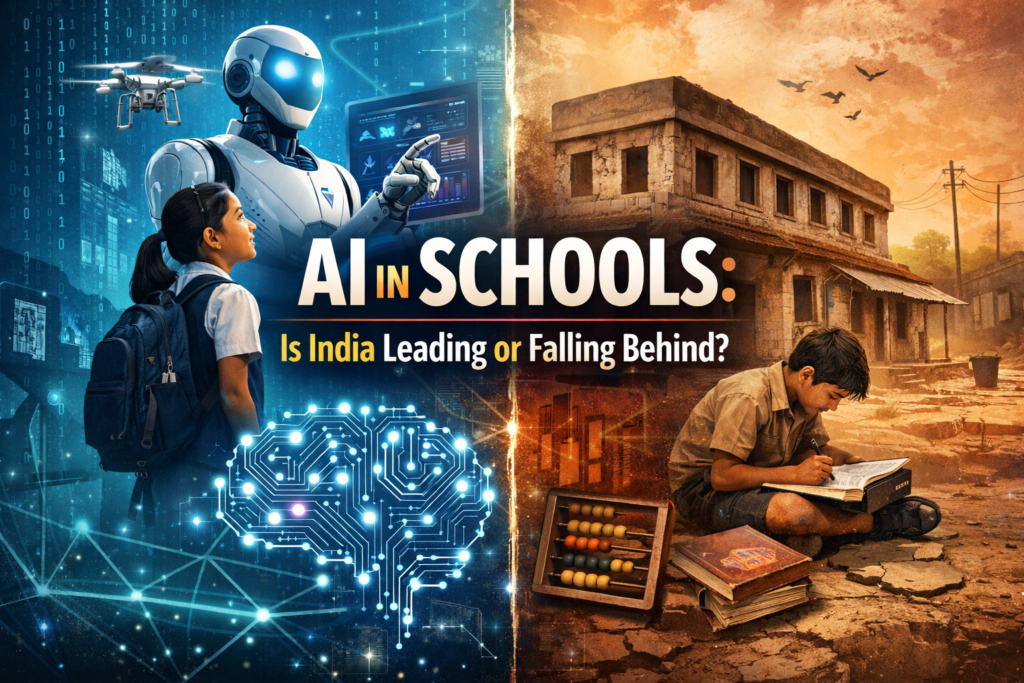
Is India Falling Behind?
Far from falling behind, India is positioning itself as a global hub for AI talent. The Indian government has launched several high-impact initiatives to bridge the digital divide:
- Mandatory AI from Class 3: Starting in the 2026-27 academic session, AI and Computational Thinking will be core subjects for all Indian students.
- The SOAR Initiative: “Skilling for AI Readiness” (SOAR) offers 45-hour modular training for Classes 6-12, focusing on “Awareness, Acquisition, and Aspiration.”
- Teacher Upskilling: A massive mission to train over 1 crore (10 million) teachers in AI-assisted pedagogy by 2026.
- National AI Portal: Platforms like DIKSHA and PM eVidya are already hosting AI-crafted modules for millions of learners.
Why Choosing an Artificial Intelligence Course in India Matters
With over 3.6 million GenAI enrollments in 2025 alone, India leads the world in AI upskilling. However, for students and professionals, quality matters more than quantity.
1. Future-Proofing Careers
By 2030, an estimated 13 million jobs in India will require AI-specific skills. An artificial intelligence course in India that covers Machine Learning, NLP, and Ethics ensures students aren’t just consumers of tech, but creators.
2. Industry-Aligned Skills
Top Indian institutions (like IIT Madras and IIT Hyderabad) now offer specialized degree programs. These courses focus on real-world applications in healthcare, logistics, and fintech.
FAQ: Navigating AI Education in India
1. When will the mandatory artificial intelligence course in India start for school students?
Under the latest Ministry of Education guidelines, AI and Computational Thinking will become mandatory for all students from Class 3 onwards starting in the 2026-27 academic year.9
2. What are the eligibility requirements for a professional artificial intelligence course in India after 12th?
For B.Tech or degree programs, students typically need a 10+2 in the Science stream (with Physics and Mathematics) and a minimum of 50-60%. Many top colleges also require entrance exams like JEE Main.
3. Are there free options for an artificial intelligence course in India?
Yes, government platforms like Swayam, NPTEL, and the “AI For All” initiative by CBSE and Intel offer high-quality, free introductory courses. Private platforms like Coursera also provide audited versions of courses from top Indian universities for free.