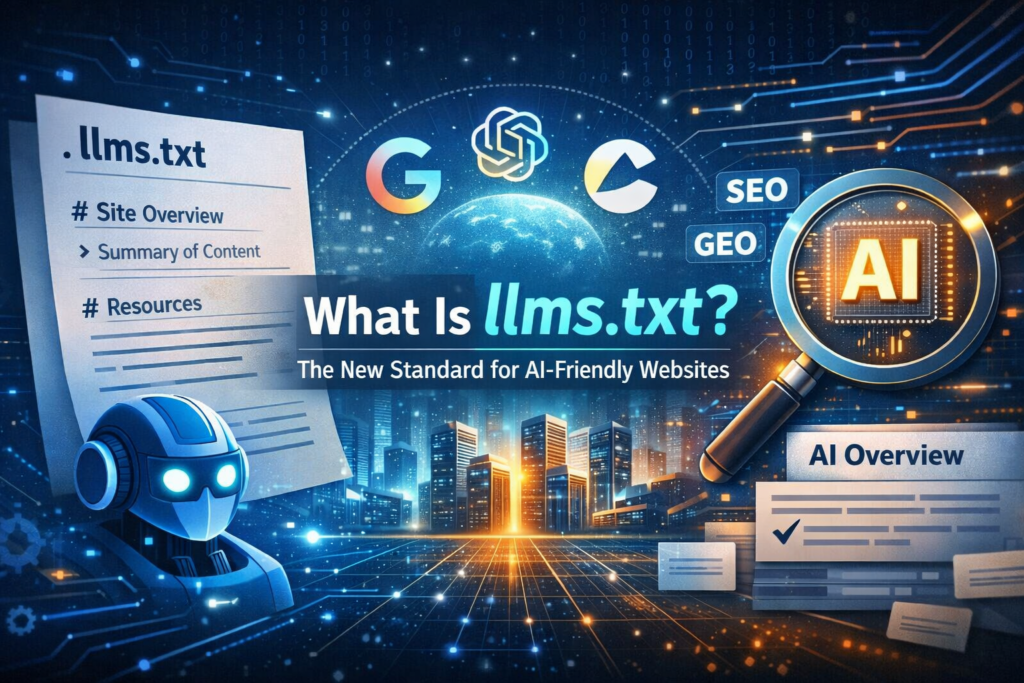
As AI-driven search evolves, developers and marketers are adopting a new standard to ensure their content is accurately interpreted by AI: the llms.txt file.
Much like robots.txt guides search engine crawlers, llms.txt is a Markdown-formatted file designed specifically for Large Language Models (LLMs). It provides a structured, text-heavy summary of your website, helping AI systems like ChatGPT, Claude, and Google Gemini process your information without getting lost in complex HTML code.
Why llms.txt Matters for SEO and GEO
Generative Engine Optimization (GEO) is the practice of optimizing content for AI responses. Implementing an llms.txt file offers several strategic advantages:
- Improved Context Discovery: It directs AI crawlers to “clean” versions of your content, ensuring the most important data is used in AI Overviews.
- Reduced “Hallucinations”: By providing a curated source of truth, you reduce the risk of AI misinterpreting your site’s JavaScript or navigation elements.
- Efficiency: LLMs have “context windows” (limits on how much text they can read at once). An llms.txt file provides a high-density summary that fits perfectly within these limits.
How to Create an llms.txt File
Creating the file is simple. Follow these steps:
- Format: Use a plain text editor to write in Markdown.
- Structure: Include an # H1 for your site name, a > Blockquote for a brief summary, and ## H2 sections for links to key resources (like APIs or guides).
- Placement: Save the file as llms.txt and upload it to your website’s root directory (e.g., yourwebsite.com/llms.txt).
- Full Version: For deep documentation, you can also create an llms-full.txt file to provide comprehensive detail.
The Future of AI Search
While not yet a universal requirement, early adopters like Anthropic, Stripe, and Cloudflare are already using this standard. As Google integrates more generative AI into its search results, having a dedicated llms.txt file positions your brand as a primary source for AI-generated answers.
Frequently Asked Questions (FAQ)
1. What is the primary purpose of an llms.txt file?
The llms.txt file serves as an AI-friendly index that provides Large Language Models with a clear, concise summary of a website’s content in Markdown format, bypassing the noise of traditional web design.
2. Does llms.txt replace the robots.txt file?
No. While robots.txt manages crawler access and permissions, llms.txt focuses on content comprehension. You should use both to ensure your site is optimized for both traditional search engines and AI models.
3. Will adding an llms.txt help me rank in AI Overviews?
Yes, it can. By providing structured, easily digestible data, an llms.txt file increases the likelihood that AI systems will cite your website as an authoritative source when generating responses for users.